Studies in zebrafish lead to better understanding of blood formation and leukemia development
Boston--Researchers at Children's Hospital Boston have isolated a gene responsible for making blood stem cells. The findings appear in today's issue of the journal Nature. The gene, called cdx4, is responsible for establishing the location of blood cell formation in the developing embryo.
Cdx4 works by altering the expression of HOX genes, which are involved in making the body plan. Surprisingly, the authors found that overexpression of cdx4 in zebrafish embryos, or in mouse embryonic stem cells, induces the new production of early blood cells.
'We have been searching for genes in the zebrafish that participate in making blood stem cells,' according to lead author, Leonard Zon, MD., of Children's Hospital Boston.
'Now that we have these genes, we are one step closer to growing more blood stem cells. This will be potentially useful for patients with severe congenital anemias or bone marrow transplantation for cancer,' adds Zon.
Scientists studied a mutant that had a severe anemia because it had few blood stem cells, and also had a tail defect. The zebrafish mutants generally die within seven to ten days after fertilization.
They discovered the mutation in the cdx4 gene, which is associated with the early blood deficiency as well as abnormal developmental patterning, including aberrant hox gene expression.
When researchers injected the mutants with hox genes, such as hoxb7a and hoxa9a, it resulted in almost complete rescue of the deficient blood cells. Another hox gene, hoxb6b showed some improvement, but hoxb8a did not have any effect on the blood defect.
Researchers believe this shows blood cell development is dependent on the proper expression of these hox genes, and that overexpression of these genes can reverse a fatal deficiency in these blood cells.
'These zebrafish findings will allow us to better understand normal blood development, with the hopes of eventually developing more effective treatments for these devastating blood disorders such as leukemia,' says Zon.
Children's Hospital Boston is home to the world's largest research enterprise based at a pediatric medical center, where its discoveries have benefited both children and adults for over 100 years. More than 500 scientists, including seven members of the National Academy of Sciences, nine members of the Institute of Medicine and nine members of the Howard Hughes Medical Institute comprise Children's research community. Founded in 1869 as a 20-bed hospital for children, Children's Hospital Boston today is a 300-bed comprehensive center for pediatric and adolescent health care grounded in the values of excellence in patient care and sensitivity to the complex needs and diversity of children and families. It is also the primary pediatric teaching affiliate of Harvard Medical School. For more information about the hospital visit: www.childrenshospital.org.
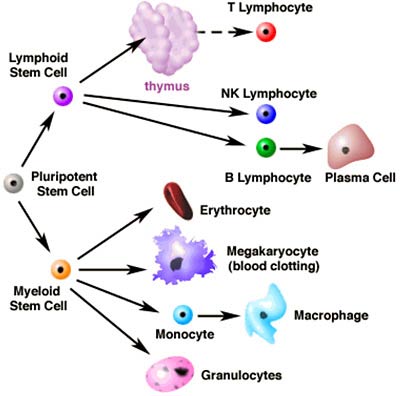
Embryonic stem cells have been encouraged to grow into sperm cells for the first time, Japanese scientists report.
The work is very preliminary, and was done in the laboratory with mouse stem cells. The next step would be to see if it can be repeated in live animals.
Stem cells are the basic building blocks of animals, forming in the new embryo and later developing into the various organs and tissues as the fetus grows.
Researchers have grown stem cells into many other types of cells, including egg cells, but this is the first time a sperm cell has been developed, the scientists said.
The work was headed by Toshiaki Noce of Mitsubishi Kagaku Institute of Life Science in Japan. The results are reported in this week's online issue of Proceedings of the National Academy of Science.
Noce and his team incubated the stem cells with other cells that produce a protein called BMP4, which is known to stimulate formation of sperm cells during the development of an embryo. In their laboratory, some of the stem cells began developing into sperm cells within one day, a process that takes three days in the embryo.
Bert Vogelstein, a professor at Johns Hopkins University who headed an Academy panel on stem cells, said the work is 'novel and provides a wonderful example of how new technologies can provide diverse cell types in the test tube that may prove useful for biomedical applications in the future.'
Growing stem cells into other tissues has been hailed as a source of major potential therapies in the future. However, the process is controversial because many stem cells are harvested from discarded embryos.
The Bush administration has limited federal funding for stem cell research to lines of cells that already exist, although new stem cell lines can be developed using private funds and in some other countries.
Study adds to evidence of adult stem cells' promising therapeutic role
BURLINGTON, VT (USA) - For the first time, researchers have demonstrated that adult human stem cell transplantation results in spontaneous cell regeneration in damaged lung tissue.
Published in the August 1 issue of the American Journal of Respiratory and Critical Care Medicine, the study further supports an existing body of research that suggests blood- and marrow-derived stem cells have the capacity to become many different human tissues.
'Many of the body's tissues once thought to be only locally regenerative may, in fact, be actively replaced by circulating stem cells after hematopoietic or blood-forming stem cell transplantation,' says lead author Benjamin Suratt, M.D., assistant professor of medicine and Vermont Lung Center researcher at the University of Vermont College of Medicine.
'This finding is of note not only for its novelty as a regenerative mechanism of the lung, but also for its vast therapeutic implications for any number of lung diseases.'
According to Suratt, the study's findings indicate that circulating stem cells are going into organ tissue and repairing damage, which could have a huge impact on the treatment of such devastating lung diseases as emphysema or cystic fibrosis.
Supported by funding from the National Institutes of Health and a National Center for Research Resources Centers for Biomedical Research Excellence grant, Suratt and his colleagues are currently looking further into what types of cells have the capacity to differentiate and generate a different type of cell, and whether these cells might be used to treat cystic fibrosis.
For more information on research taking place at the Vermont Lung Center at the University of Vermont, go to www.vermontlung.org
To link to the article abstract, go to:
ajrccm.atsjournals.org/cgi/content/abstract/168/3/318

